Changing a biscuit tray changes a physical structure inside a larger package. A useful design brief must cover how the new tray separates from the stack, supports the product and passes through wrapping, with the outer film considered alongside it.
Mondelēz’s September 2026 paper-tray announcement provides the case background. Our checklist below proposes questions for another design project; it does not describe the company’s equipment or trial results.
Read the reported change at its stated boundary
The Mondelēz Benelux announcement dated September 8, 2026 says the company replaced rigid PET trays with paper trays across more than 115 European cookie products. The company describes FSC-certified paper and a reduction in virgin plastic. Its footnote bases the approximately 80% comparison on the previous outer film and PET tray combined, using projected annual production. That percentage is not a tray-only performance result.
Packaging World covered the change on September 24 in its paper-tray report. The company announcement and reporting do not establish a universal line conversion method, shelf-life equivalence or recycling outcome for a different tray.
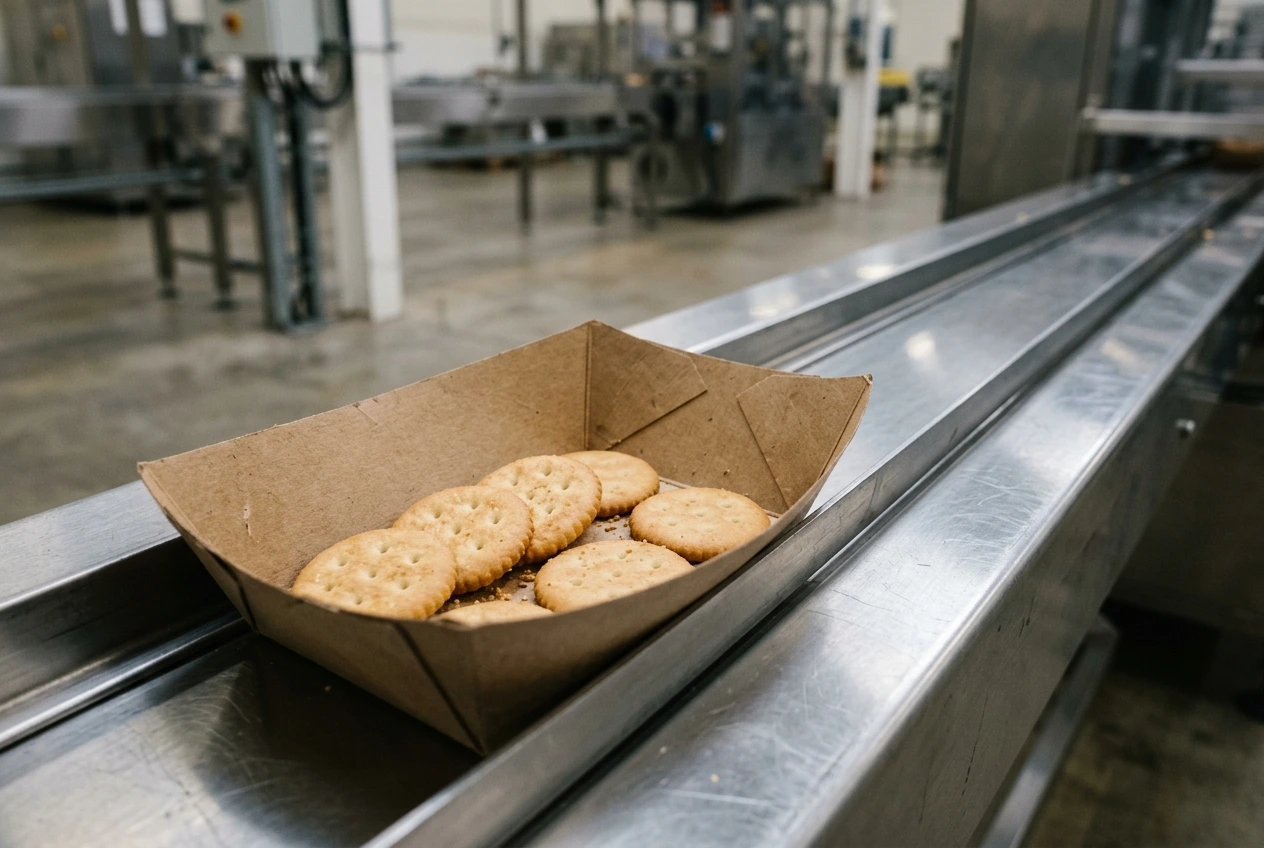
The generic folded tray illustrates product support and corners. It is not a Mondelēz package and shows no measured breakage result.
Specify the tray as a supplied part
Describe the incoming tray state, material specification, folds, joints and how trays are stacked. Record the drawing revision and identify the features a denesting or conveying operation touches. The material name alone does not define those features.
Ask the converter for representative samples made by the intended process. A hand-folded prototype can help assess shape, but its edges, stiffness and stacking behaviour may not represent the delivered production part. Keep that limitation on the sample record.
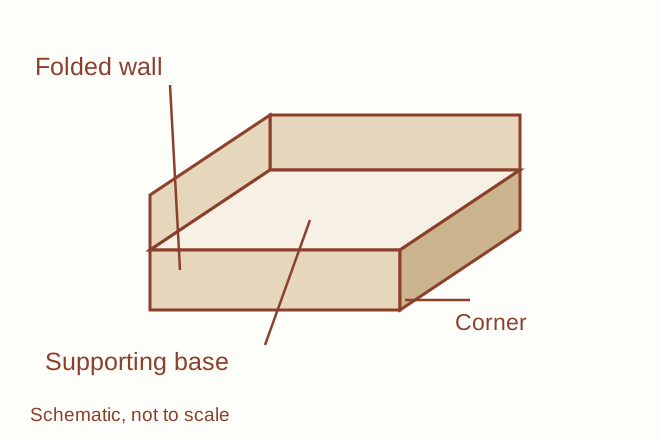
The schematic highlights a folded corner and the tray’s supporting surface. It proposes features to examine without assigning load capacity, friction or forming tolerances.
Write the trial questions before changing artwork
| Review area | Question for the design brief | Evidence to request |
|---|---|---|
| Stack separation | Can the supplied trays separate reliably in the intended arrangement? | Representative stack and observed trial events |
| Product support | Where does the product bear on the base and walls? | Loaded samples and agreed damage assessment |
| Edges and folds | Can a raised or sharp feature contact the wrapper? | Formed samples, drawing and contact observation |
| Wrap clearance | Does the outer film accommodate the loaded structure? | Film reference and complete wrapped samples |
| Product protection | Which barrier and shelf-life requirements belong to the complete pack? | Product-specific evaluation plan and results |
| Pack claim | What precise material or reduction statement is supported? | Defined comparison and evidence owner |
The design team should describe its acceptance decisions and let the responsible line and quality specialists set appropriate evaluation methods. No generic paper-tray checklist supplies those limits.
Observe the complete packaging sequence
Run the relevant denesting, loading and wrapping operations with the intended product condition. Record machine configuration and sample identity. If a tray deforms, note where and when it happened. Preserve the sample rather than attributing the result to “paper” as a whole.
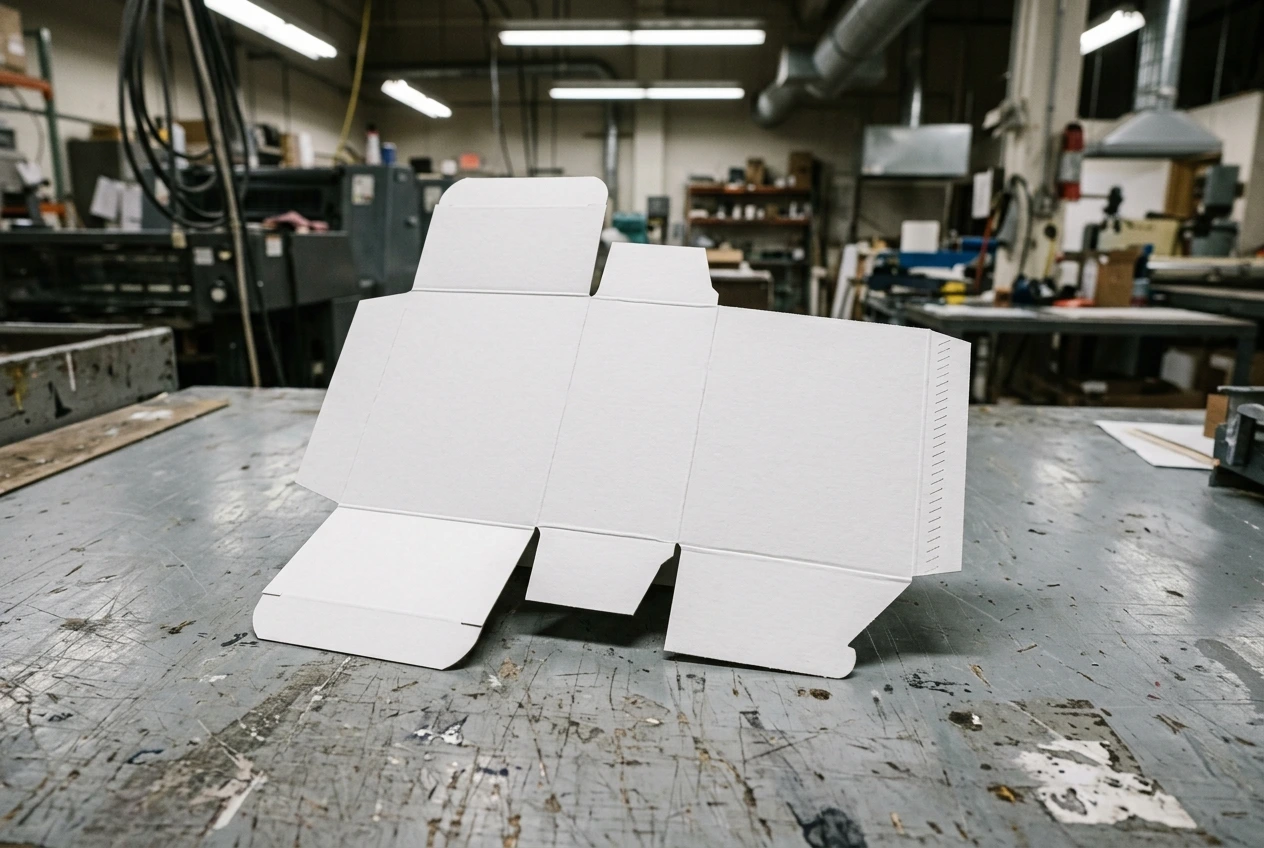
The carton blank shows a related design issue: a flat shape and its folded state need a controlled relationship. For a tray, confirm which folds and joints are formed by the converter and which, if any, are completed at the packing line. Do not assume the visible final shape explains the incoming supply format.
Keep claim review beside the structural release
A material certificate, a plastic reduction calculation and evidence about the finished package’s end of life answer different questions. Store them separately. Describe the baseline and package components included in any reduction comparison, and identify the markets and period to which it applies.
Release the new design with the material record, drawing, complete-pack samples and trial outcome. Keep any unresolved protection or handling question visible. See the dieline handoff guide for drawing control and the case-study category for the evidence boundary used in these analyses.